How to Meditate with Crystals: A Beginner's Guide to Mindful Crystal Practice
Quick Answer
Meditating with crystals is a simple practice that combines the benefits of mindfulness with the symbolic presence of a natural stone. This guide covers why people meditate with crystals, how to choose one, four methods for crystal meditation, and how to build a sustainable daily practice.
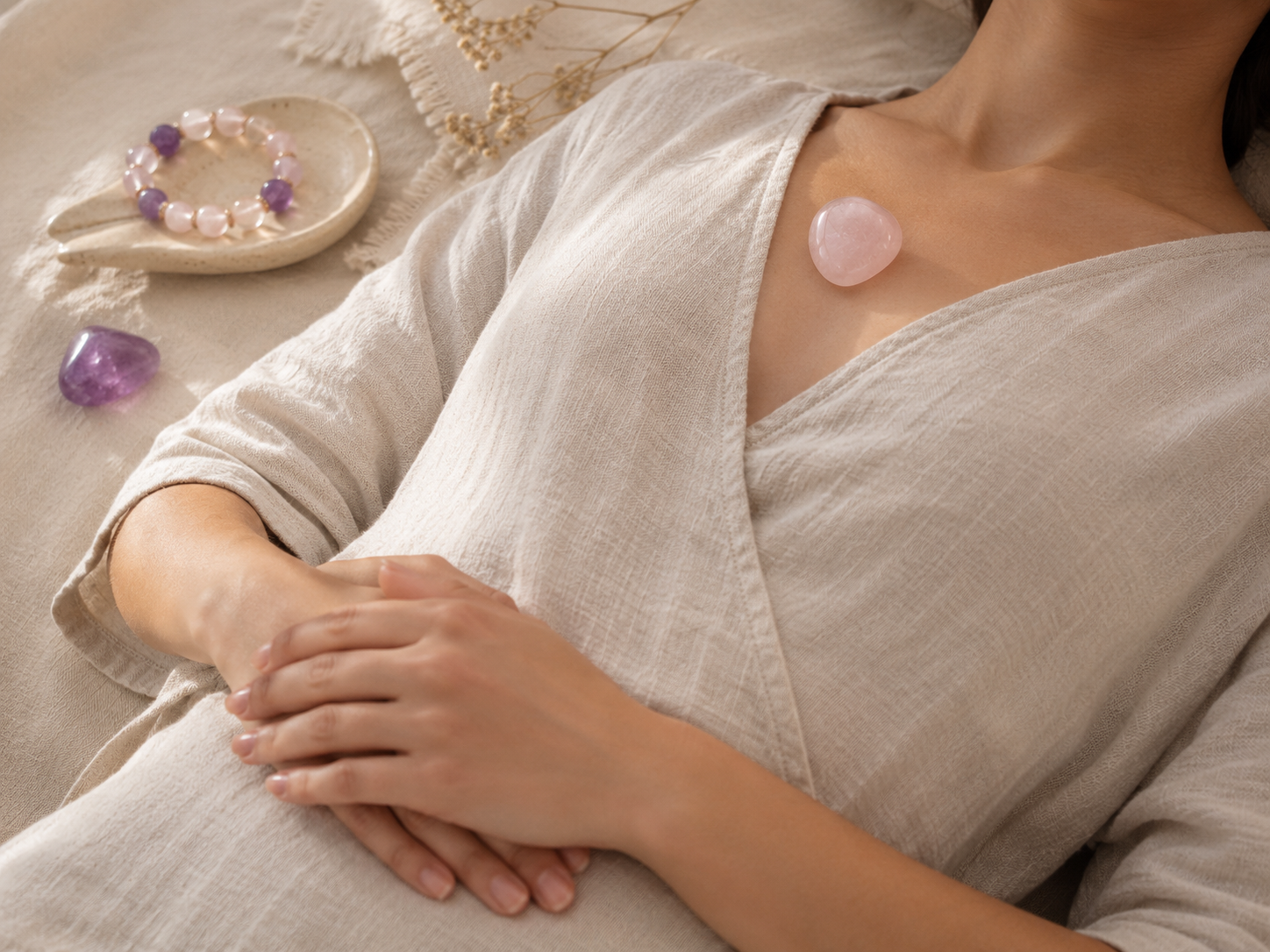
Meditation is one of the oldest ways humans have found to quiet the mind. Adding a crystal to that practice does not require any special belief system — it simply gives your attention somewhere gentle to rest. A stone in your hand is a physical anchor, something real to return to when your thoughts wander.
This guide covers how to meditate with crystals in a way that is practical, beginner-friendly, and grounded. No prior experience is needed, and you do not need to memorize any crystal properties to begin.
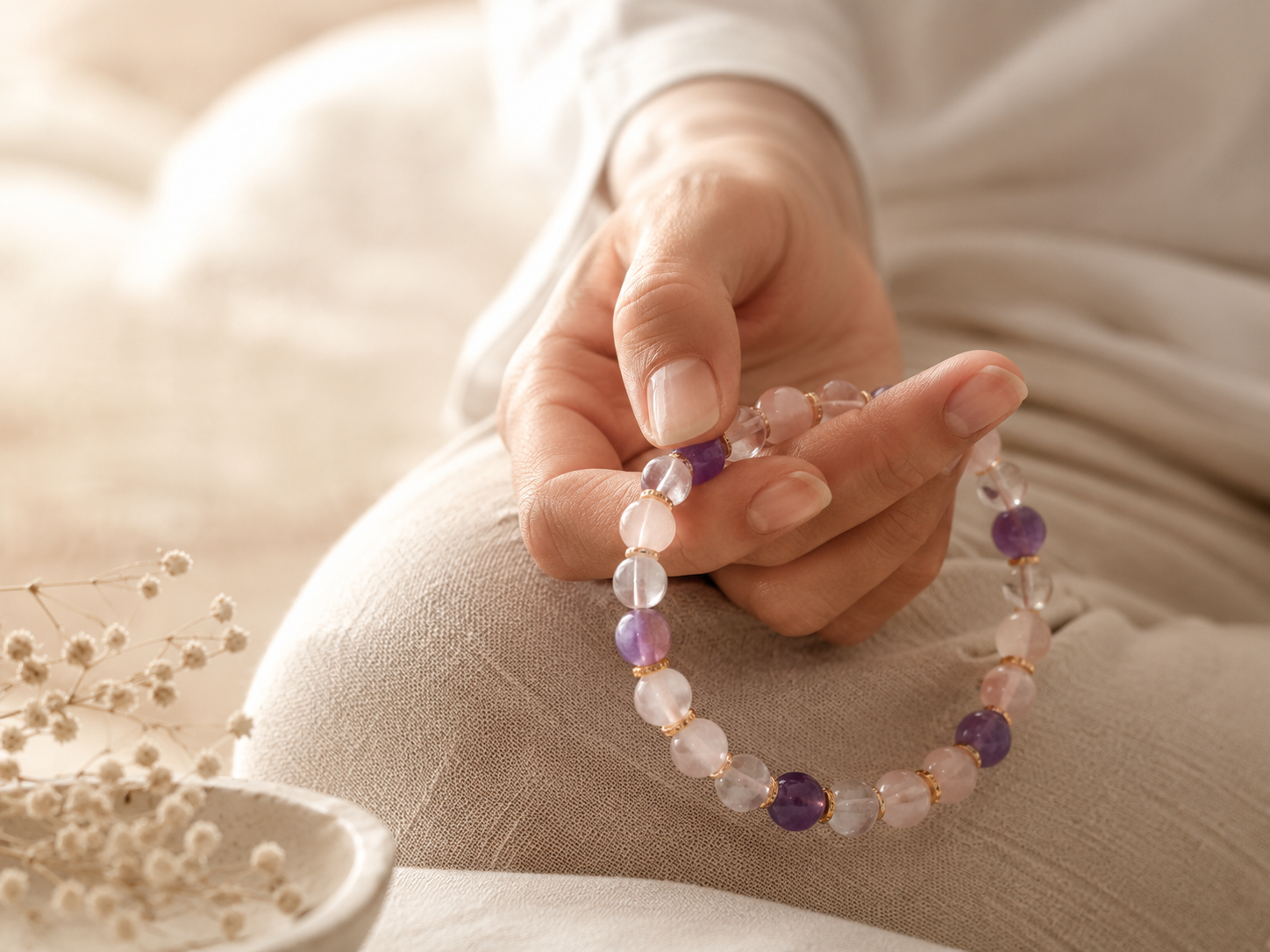 Crystal bracelet resting on a linen cloth beside a lit candle
Why Meditate with Crystals?
You do not need a crystal to meditate. People have meditated for thousands of years with nothing but their breath. So why add one?
There are three practical reasons:
1. A Physical Anchor for Your Attention
The hardest part of meditation is not sitting still — it is noticing when you have drifted and gently coming back. A crystal gives your hands something to do. When you hold a bead, run your thumb over a stone, or feel its weight in your palm, that tactile sensation becomes a cue. Every time you notice the stone, you have a chance to return to your breath.
This is the same principle behind mala beads and worry stones. The object is not doing the meditation for you. It is giving you a handle.
2. A Symbolic Reminder of Your Intention
If you chose a crystal because of what it traditionally symbolizes — amethyst for calm, rose quartz for self-compassion, obsidian for grounding — holding that stone during meditation becomes a quiet reminder of why you sat down in the first place. You are not asking the crystal to do something. You are using it to remember your own intention.
3. A Ritual Object That Helps You Begin
One of the biggest barriers to meditation is simply starting. Having a dedicated crystal that you hold only during meditation turns the act of picking it up into a small ritual. Rituals help the brain shift gears. Over time, the stone becomes a cue — the way a yoga mat cues practice, or a journal cues writing.
How to Choose a Crystal for Meditation
If you are new to this, do not overthink it. Choose one stone and use it for two weeks before trying another. Here is a simple framework:
| Intention | Traditional Stone | Why People Choose It |
|---|---|---|
| Calm and rest | Amethyst | Traditionally associated with stillness and intuition |
| Self-compassion | Rose Quartz | Traditionally associated with love in all forms |
| Focus and clarity | Clear Quartz | Traditionally seen as an amplifier of intention |
| Grounding | Black Obsidian | Traditionally associated with protection and stability |
| Confidence | Tiger's Eye | Traditionally associated with courage and action |
| Gentle optimism | Lemon Quartz | Traditionally associated with focus and warmth |
If none of these feel right, trust your eye. The stone you keep noticing is often the one to start with. Read more in our crystal beginner guide.
A meditation bracelet works especially well because the beads are already strung for touching — you can move from bead to bead as you breathe.
Four Methods for Crystal Meditation
Method 1: Holding a Crystal During Breath Meditation
This is the simplest method and the best place to start.
- Sit comfortably. You do not need to cross your legs — a chair is fine.
- Hold your crystal in one hand, or place it in your lap.
- Close your eyes and take three slow breaths.
- Let your breath settle into its natural rhythm.
- Each time you notice you are thinking, feel the stone in your hand and return to your breath.
You do not need to direct energy, visualize anything, or focus on the crystal itself. It is simply there. Start with five minutes and build up slowly.
Method 2: Bead-by-Bead Breathing
This method uses a crystal bracelet as a breathing anchor. It is especially helpful if your mind tends to race.
- Hold your bracelet in your dominant hand.
- Place your thumb on the first bead.
- Inhale slowly through your nose for 4 seconds.
- Move your thumb to the next bead.
- Exhale slowly through your mouth for 6 seconds.
- Continue bead by bead until you have gone around the bracelet once.
This is a form of mindful breathing with a tactile cue. The longer exhale activates your parasympathetic nervous system, which is the body's natural calming signal. A full round usually takes 3–5 minutes — a perfect length for a beginner session.
Method 3: Crystal on the Body
This method comes from traditions that map energy centers (chakras) along the spine. You do not need to believe in chakras to use it — the practice is simply a structured way to place your attention on different parts of your body.
- Lie down on your back.
- Place one crystal on or near a body center. Common placements:
- Chest — for self-compassion or heart-centered intention (rose quartz)
- Forehead — for focus or intuitive intention (amethyst or clear quartz)
- Lower belly — for grounding or stability (obsidian)
- Close your eyes and breathe naturally.
- If your mind wanders, gently return your attention to where the stone rests.
If the stone feels too heavy or awkward on a body part, place it beside you at the same height. Start with 10 minutes.
Method 4: Intention Setting with Affirmation
This method pairs your crystal with a short phrase that reflects your intention. It combines meditation with a simple form of mental rehearsal.
- Hold your crystal and take three slow breaths.
- Silently repeat a phrase that matches your intention. Examples:
- "I can meet this moment with calm."
- "I am allowed to take up space."
- "I trust myself to act clearly."
- As you repeat the phrase, imagine a situation where you would normally feel stressed, and picture yourself responding the way the phrase describes.
- Continue for 5–10 minutes.
The crystal here is a physical token of the intention. Over time, picking up that stone becomes a cue that brings the phrase — and the feeling — back.
How Long Should I Meditate with a Crystal?
Start short. Ten to fifteen minutes is plenty for a first session. If you try to do too much too fast, you may feel restless or emotionally stretched — not because the crystal is doing something dramatic, but because meditation itself surfaces whatever you have been avoiding.
Build up slowly. A sustainable practice is better than a heroic one. Five minutes a day for a month will change more than an hour once a week.
If you find yourself getting sleepy during a session, that is normal. Sometimes the body uses stillness to catch up on rest. Let yourself drift if you need to — you can meditate again tomorrow.
Building a Daily Crystal Meditation Practice
The goal is not a perfect session. The goal is to come back. Here is a simple structure:
| Time | Practice |
|---|---|
| Morning (2 min) | Hold your crystal, set an intention for the day, take 5 slow breaths |
| Midday (2 min) | Bead-by-bead breathing to reset between tasks |
| Evening (5 min) | Crystal-on-body meditation or intention reflection |
This adds up to about 9 minutes a day. That is enough to feel a difference within two weeks, and it is short enough that you will not skip it on busy days.
Keep your crystal somewhere visible — beside your bed, on your desk, or in your pocket. The more you see it, the more often you will pick it up.
Common Questions from Beginners
"I can't feel anything from my crystal. Am I doing it wrong?"
No. You do not need to feel anything. The crystal is an anchor, not a battery. If your meditation feels calm and your mind wanders less, that is the practice working.
"Do I need to cleanse my crystal before meditating?"
It is a good habit, especially if the stone has been handled by many people. Place it in moonlight overnight or on a selenite plate. Learn more in our crystal beginner guide.
"Can I use more than one crystal at a time?"
Yes, but it is best to start with one. Once you are comfortable, you can combine stones — for example, amethyst for calm and rose quartz for self-compassion. Add slowly and notice how each combination feels.
"What if I fall asleep?"
That is fine. Sleep is one way the body processes. If you consistently fall asleep, try meditating earlier in the day or sitting upright instead of lying down.
A Note on What Crystals Are — and Aren't
Crystals are natural objects formed over thousands to millions of years inside the earth. They have real physical properties — quartz is piezoelectric, obsidian is volcanic glass, amethyst is purple quartz. These properties are well documented.
The traditional meanings associated with crystals — rose quartz for love, amethyst for calm — come from centuries of cultural practice, not from clinical studies. Whether you see those meanings as symbolic, intuitive, or simply pleasant stories is up to you. What is well documented is that the ritual of meditation itself reduces stress and improves focus. The crystal is a beautiful, ancient tool that helps you do that practice.
If you are experiencing persistent anxiety, low mood, or sleep problems, please talk to a healthcare professional. A crystal can be part of your self-care, but it is not a substitute for medical care.
Ready to Start?
You do not need much. One crystal. A few minutes. The willingness to sit with yourself.
Browse our crystal bracelet collection to find a stone that matches your intention, or design a custom bracelet for your daily practice.
Frequently Asked Questions
How do I meditate with crystals for the first time?+
Which crystal is best for meditation?+
Do I need to believe in crystal energy to meditate with them?+
How long should I meditate with a crystal?+
Can I sleep with a crystal bracelet on?+
What does it mean if I feel nothing during crystal meditation?+
Can I use multiple crystals at once?+
Do crystals need to be cleansed before meditation?+
Is crystal meditation a replacement for therapy or medication?+
+
Ready to Find Your Crystal Bracelet?
Browse our hand-selected collection or design your own custom bracelet.