Super Seven Crystal: Meaning, Formation, and Why It Contains Seven Minerals
Quick Answer
Super Seven is a rare quartz variety containing seven naturally occurring minerals: amethyst, clear quartz, smoky quartz, rutile, cacoxenite, goethite, and lepidocrocite. Learn how it forms, what each mineral contributes, and how to choose and care for Super Seven jewelry.
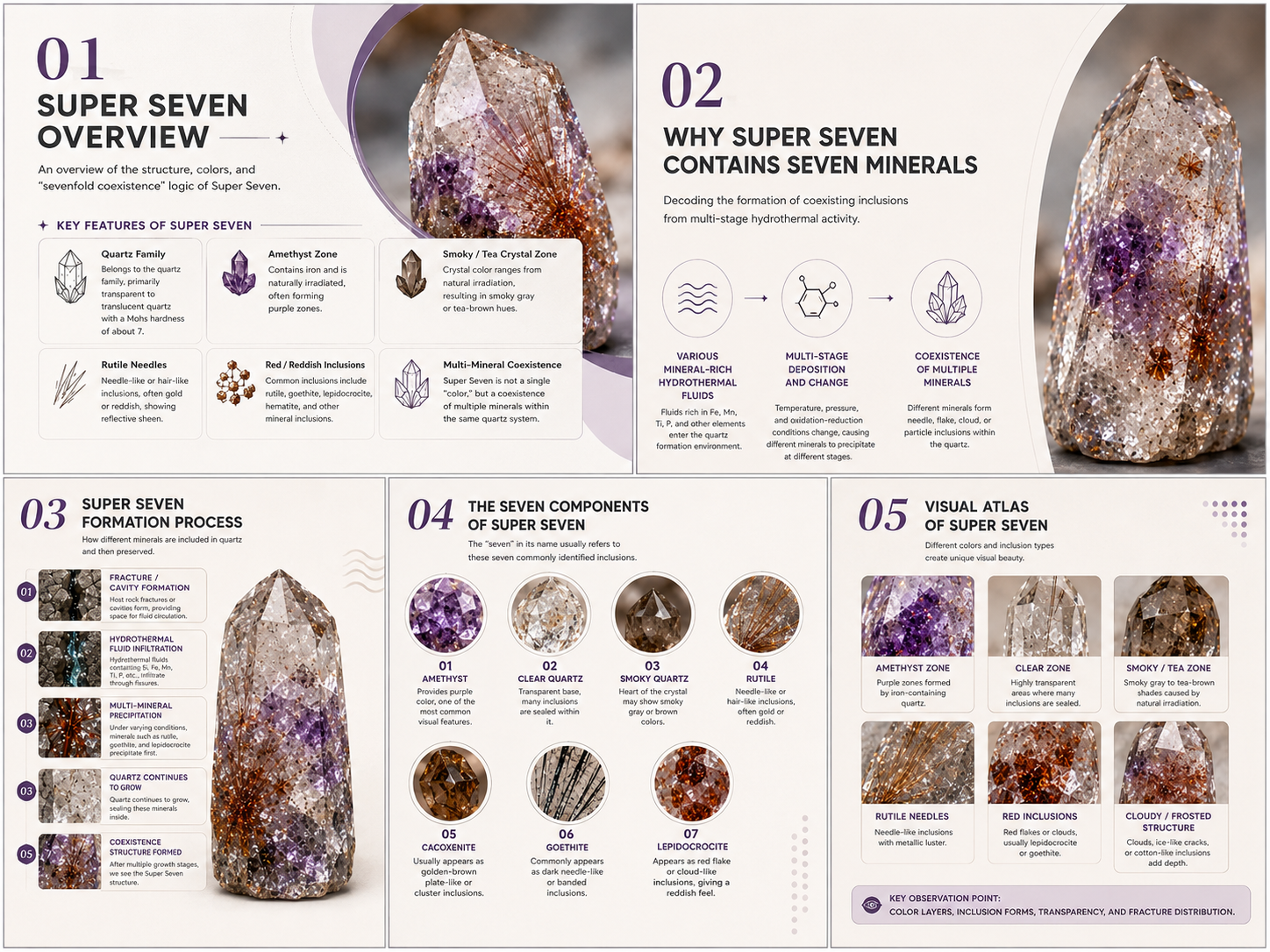
Super Seven is one of the most visually complex crystals you can hold in your hand. One stone might show deep purple amethyst zones, smoky gray patches, golden needle-like flashes, and rust-red mineral clouds — all locked inside the same transparent quartz body.
Despite the name, Super Seven is not seven separate crystals glued together. It is one quartz crystal that, through a rare series of geological events, naturally trapped seven different minerals inside itself. This guide explains what Super Seven is, how it forms, what each mineral contributes, and how to choose and care for it — whether you are buying a specimen, a bracelet, or simply want to understand what you are looking at.
 Super Seven crystal point showing layered purple, smoky, and golden inclusions
)
Super Seven crystal point showing layered purple, smoky, and golden inclusions
)
What Is Super Seven?
Super Seven belongs to the quartz family. Its main body is clear to translucent quartz with a glassy luster, and its chemical composition is still dominated by SiO₂. What makes it special is not the quartz itself, but what got caught inside it.
The "seven" refers to seven minerals that commonly occur together in this material:
- Amethyst
- Clear Quartz
- Smoky Quartz
- Rutile
- Cacoxenite
- Goethite
- Lepidocrocite
These minerals do not sit on top of the crystal. They are embedded within it — sometimes as visible needles, sometimes as faint clouds, and sometimes as microscopic grains that are only detectable under magnification. That is why two Super Seven stones can look completely different from each other, even though they carry the same name.
Super Seven is sometimes called Melody Stone, especially in collector circles, though the name "Super Seven" is the broader trade term for this multi-mineral quartz material.
The Seven Minerals and What They Look Like
| Mineral | Role in Super Seven | Typical Appearance |
|---|---|---|
| Amethyst | Provides purple color | Purple zones or patches, light to deep violet |
| Clear Quartz | Forms the main crystal body | Transparent to translucent areas |
| Smoky Quartz | Adds gray-brown tones | Smoke gray, tea brown, or dark amber areas |
| Rutile | Creates golden flashes | Thin needle-like or hair-like inclusions, gold to copper red |
| Cacoxenite | Adds radiating clusters | Golden-brown radial or starburst patterns |
| Goethite | Creates dark linear inclusions | Black, brown, or yellowish needle-like or banded forms |
| Lepidocrocite | Adds reddish clouds | Reddish-brown plates, flakes, or wispy cloud-like inclusions |
Some pieces show all of these clearly. Others show only two or three with the rest hidden inside the crystal structure. This is normal, and it is one of the first things collectors learn: what you see is only part of the story.
How Super Seven Forms
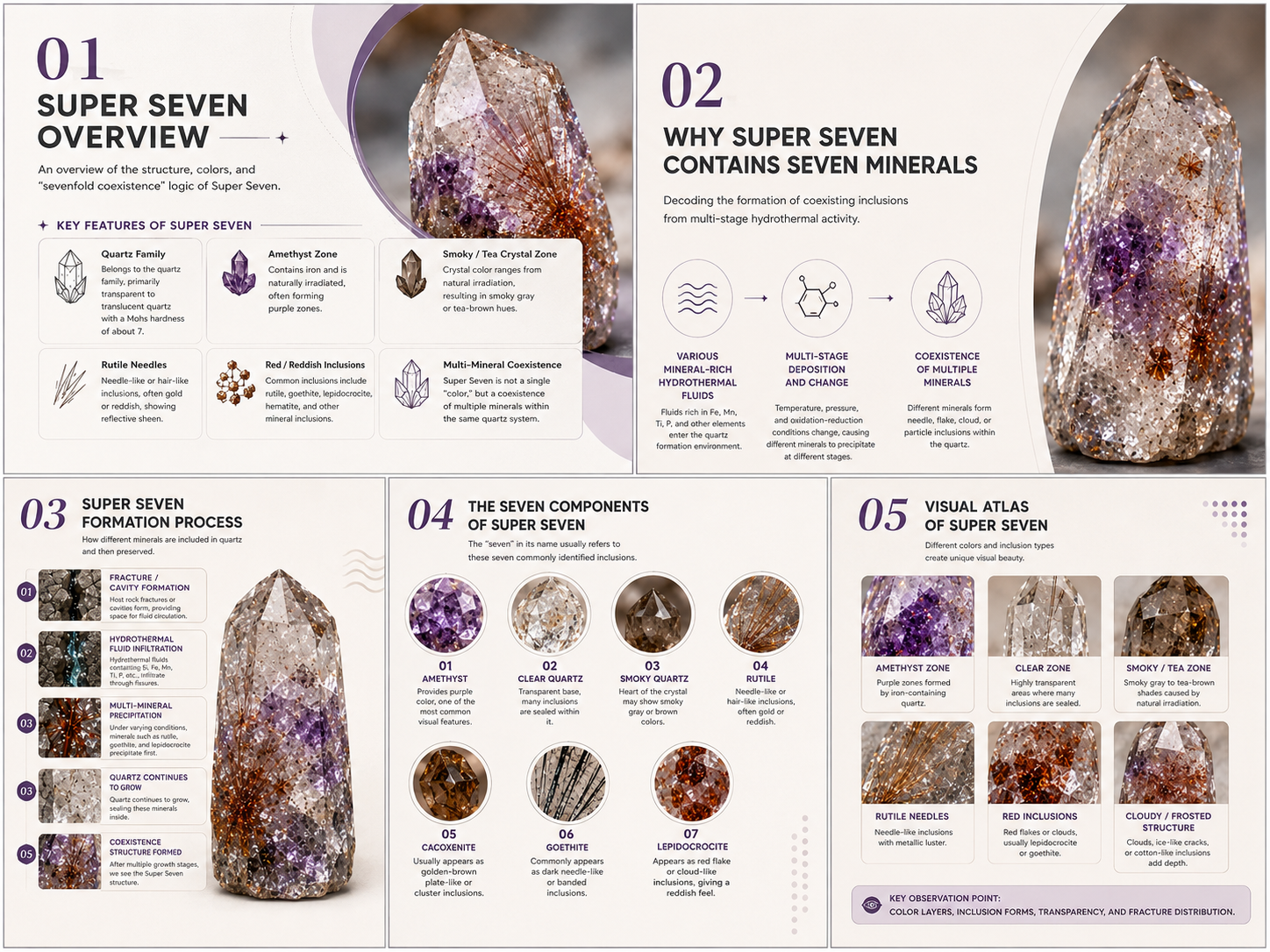
Super Seven does not form in a single event. It is the result of multiple hydrothermal events — hot, mineral-rich fluids moving through cracks and cavities in the Earth's crust — over a long period.
Here is the simplified sequence:
-
A crack or cavity forms. Deep underground, rocks fracture or open into small cavities and geodes, creating space.
-
Silica-rich fluid enters. A hot fluid carrying dissolved silica moves into these openings and begins to crystallize quartz, forming the main crystal body.
-
Different mineral fluids follow. Later fluids, carrying iron, phosphorus, titanium, and other elements, enter the same space under changing temperature and pressure conditions. These fluids deposit minerals like rutile, goethite, cacoxenite, and lepidocrocite.
-
Quartz continues to grow. As the quartz crystal keeps growing, it envelopes the earlier minerals, sealing them inside.
-
The result is a multi-mineral record. The finished Super Seven crystal is essentially a geological diary — each inclusion marks a different stage of fluid activity.
This multi-stage formation is why Super Seven is considered a coexistence system rather than a single-mineral stone. The minerals are not mixed randomly; they are trapped in a specific order, layer by layer, as the crystal grew.
Where Super Seven Is Found
Super Seven forms in environments closely related to quartz hydrothermal systems. The most common settings include:
- Hydrothermal veins: Silica-rich fluids move upward along fractures and crystallize quartz with inclusions inside the vein.
- Granite-related fractures: Late-stage magmatic fluids create quartz veins and small geodes in and around granite bodies.
- Geodes and cavities: Open spaces allow crystals to grow into more complete, well-formed shapes.
- Iron-rich oxidation zones: When iron-rich fluids are involved, the stone is more likely to develop reddish-brown lepidocrocite and goethite features.
These environments are found in several parts of the world, though Brazil is one of the best-known sources for high-quality Super Seven material.
Why You Cannot Always See All Seven Minerals
This is one of the most common points of confusion. A buyer might expect every Super Seven stone to display all seven minerals clearly, but that is rarely the case.
There are four reasons:
1. Cutting and Polishing Hide or Reveal Different Things
The angle and location of a cut determine which inclusions are exposed. A slice through one part of the crystal might show dense rutile needles. A slice through another part might show mostly clear quartz.
2. Mineral Content Is Not Evenly Distributed
Some minerals are abundant in a particular piece; others appear only as tiny specks. One stone might be dominated by amethyst and rutile, while another carries more goethite and lepidocrocite.
3. Some Minerals Are Microscopic
Certain inclusions are too small to see with the naked eye. They may only become visible under magnification or even require advanced testing.
4. Color Does Not Equal Mineral Count
A stone that looks mostly purple might still contain multiple microscopic inclusions besides amethyst. Likewise, a clear-looking section might hold rutile or cacoxenite that is simply aligned away from the light.
Selection tip: Do not count "how many colors you can see." Look instead for clarity, natural-looking inclusions, layered color depth, and an overall sense that the stone has real geological complexity.
Super Seven in Human Use
Super Seven sits at the intersection of mineral collecting, jewelry, and education. It is not just a beautiful stone — it is a teaching tool for understanding how crystals grow.
Mineral Specimens and Collections
Pieces with rich, layered inclusions are highly valued as display specimens. Collectors look for contrast: purple amethyst zones against golden rutile sprays, or red lepidocrocite clouds suspended in clear quartz.
Beads and Jewelry
When cut into beads, Super Seven becomes a wearable piece of geology. The appeal is visual: each bead carries its own pattern of transparency, color layers, and internal features. No two bracelets look the same.
Teaching and Observation
Super Seven is an excellent stone for learning about inclusions, mineral coexistence, and quartz growth structures. Looking at one piece under a loupe can teach you more about crystal formation than many textbooks.
Care and Handling
Even though quartz has a Mohs hardness of about 7, Super Seven needs careful handling because of its inclusions and internal fractures.
- Avoid impact. Internal fractures can spread if the stone is knocked.
- Keep away from strong acids. Acids can damage iron-bearing inclusions and surface polish.
- Do not use ultrasonic cleaners if the stone has visible cracks or loose inclusions.
- Store jewelry separately. Super Seven beads can scratch softer stones and be scratched by harder ones.
- Clean gently. A soft, dry cloth is enough for daily care.
What Super Seven Means Traditionally
Because Super Seven contains amethyst, clear quartz, smoky quartz, rutile, and other minerals, it carries a mix of traditional associations:
- Amethyst is traditionally associated with calm and intuition.
- Clear Quartz is traditionally seen as an amplifier of intention.
- Smoky Quartz is traditionally associated with grounding.
- Rutile is often described as a stone of illumination and focus.
- Cacoxenite, Goethite, and Lepidocrocite add earthy, grounding tones.
In crystal communities, Super Seven is sometimes called a "stone of connection" because it brings together so many mineral energies in one piece. Whether you view that literally or symbolically, the visual result is undeniably striking: a single crystal that holds millions of years of geological history.
How to Choose Super Seven Jewelry
If you are buying a Super Seven bracelet or pendant, here is what to look for:
- Transparency: Higher clarity lets you see the internal landscape better.
- Natural inclusions: Look for inclusions that seem to belong to the stone, not artificially added.
- Color layering: Good pieces show depth — purple, gray, gold, and red tones at different levels.
- Durability: Avoid beads or stones with large surface-reaching cracks.
- Comfort: Super Seven beads can feel slightly textured because of inclusions; make sure the finish is smooth against the skin.
Because every piece is different, the stone you see in the photo should be the stone you receive. This is especially important for Super Seven, where the pattern is the entire value.
Browse our crystal bracelet collection to see current Super Seven pieces, or design a custom bracelet with the stones that match your intention.
Final Thoughts
Super Seven is not a marketing trick. It is a real geological phenomenon: a quartz crystal that grew through multiple hydrothermal events and naturally trapped seven different minerals inside itself. Some pieces display all seven minerals dramatically. Others keep most of them hidden. Both are genuine.
What makes Super Seven special is that it turns a single stone into a small museum. Hold it to the light, and you are looking at ancient fluids, changing pressures, and minerals that crystallized at different moments in time — all frozen inside one crystal.
Frequently Asked Questions
What is Super Seven crystal?+
What are the seven minerals in Super Seven?+
Why is it called Super Seven?+
Can you see all seven minerals in every Super Seven stone?+
What does Super Seven look like?+
Where does Super Seven come from?+
Is Super Seven the same as Melody Stone?+
How hard is Super Seven?+
Can Super Seven go in water?+
How do I clean Super Seven jewelry?+
What is Super Seven traditionally associated with?+
How do I know if my Super Seven is real?+
Ready to Find Your Crystal Bracelet?
Browse our hand-selected collection or design your own custom bracelet.